The cards below are refreshed weekly from my NASA ADS library, with a representative figure extracted from each paper and a short plain-language summary of its abstract. For the complete publication record see my ADS library or my ORCID profile.
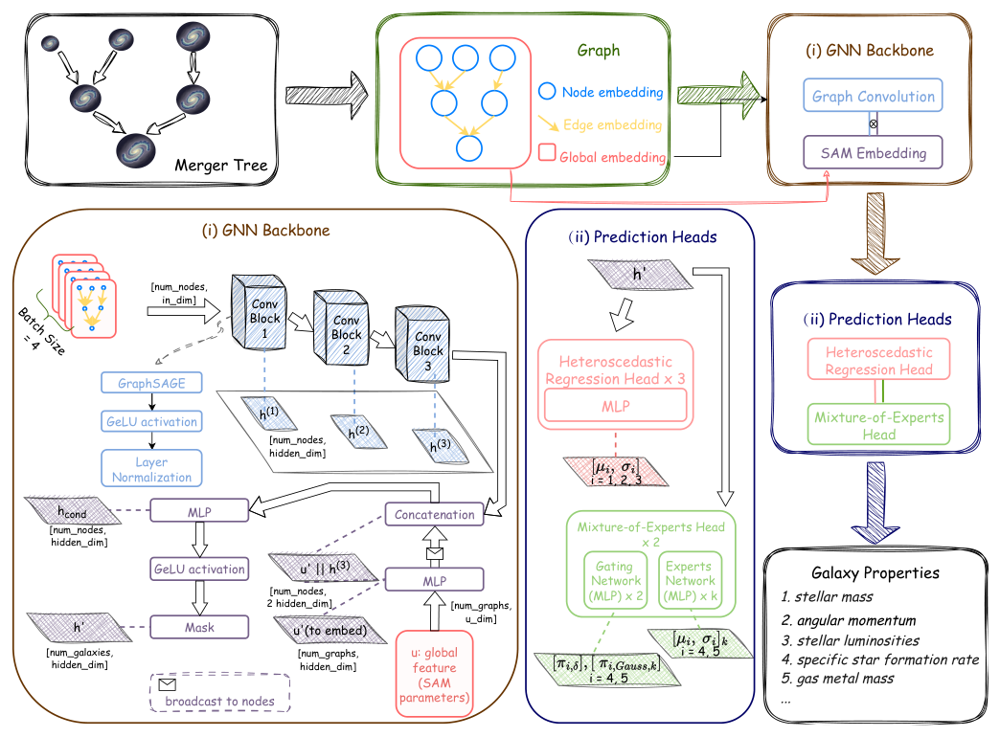
A Graph-based Neural-network Surrogate Model for an Accelerating Semianalytical Model of Galaxy Formation and Evolution
A neural network that works directly on the branching histories of dark matter halos reproduces the galaxy properties predicted by a full semi-analytic model — stellar mass, luminosity, rotation, gas metal content, and star formation rate — over the first twelve billion years of cosmic time, matching stellar masses to within 0.19 to 0.28 dex. A single such surrogate holds up across different model parameter choices and halo histories, offering a fast stand-in when exploring the parameter space of galaxy formation models.
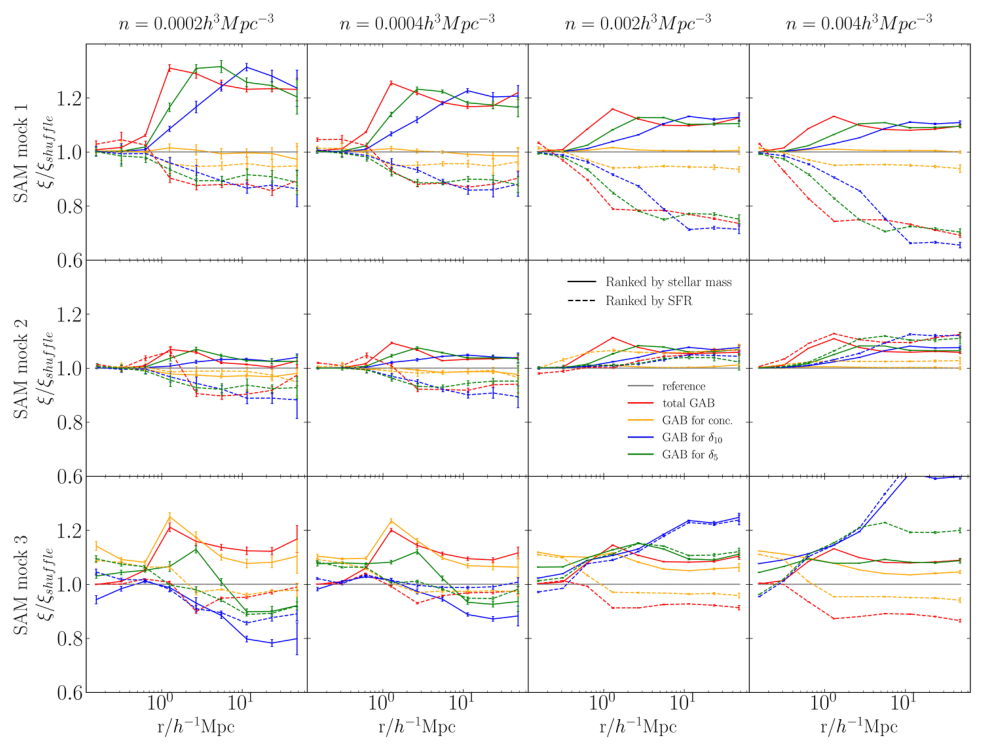
Correlation between Baryonic Process and Galaxy Assembly Bias
For galaxies picked by their mass in stars, the extra clustering that depends on more than the mass of their dark matter halos tracks most closely how gas cools and how stars blow gas back out, regardless of how common the galaxies are. For galaxies picked by how fast they form stars, the most closely linked process shifts from star formation itself to gas cooling as the sample includes more common galaxies.
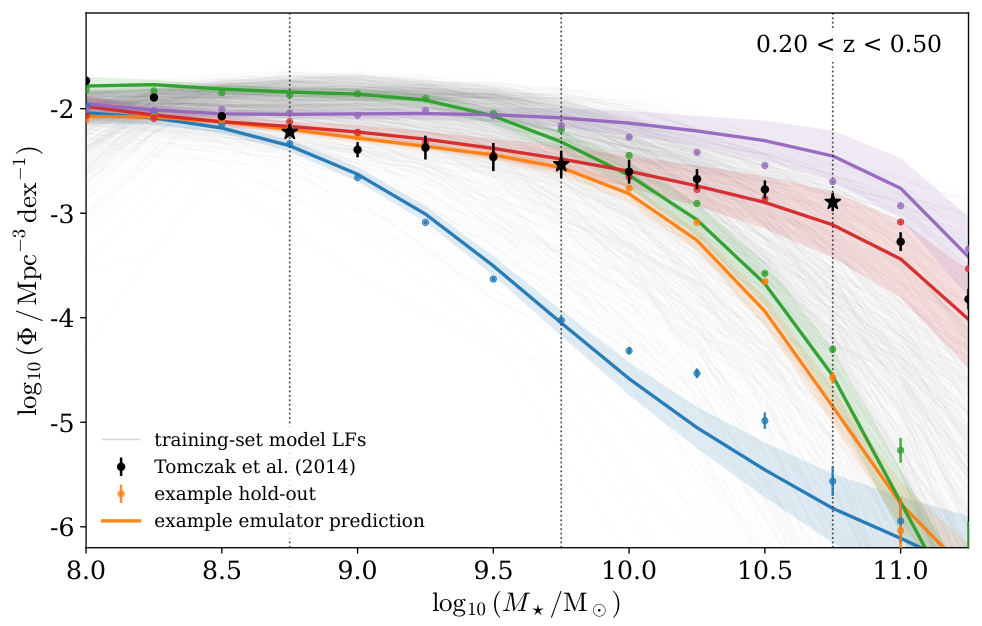
Emulator-Assisted Calibration of a Semi-Analytic Galaxy Formation Model for the Roman Galaxy Redshift Survey
Fast statistical stand-ins for the Galacticus galaxy formation model make it practical to calibrate it against several sets of observations at once — galaxy masses, sizes, star formation rates, metallicities, central black hole masses, and hydrogen line emission — which breaks degeneracies that fits to any single dataset leave unresolved and exposes where observations pull in different directions. The calibrated model reproduces the abundance and evolution of hydrogen-line-emitting galaxies, making it suitable for building mock catalogues for the Roman Galaxy Redshift Survey.
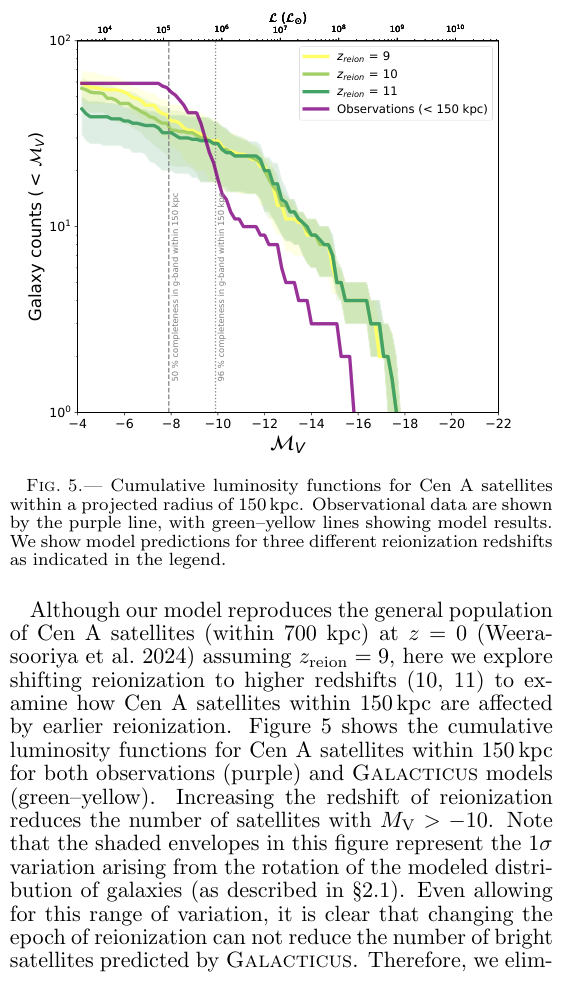
The Curious Case of Centaurus A: On the Subject of the Quenched satellites
Models calibrated to the Milky Way overpredict the number of bright satellite galaxies within 150 kpc of Centaurus A by a factor of four, and chance alone cannot account for the shortfall. The missing satellites occupy the same region as Centaurus A's kiloparsec-scale radio lobes, and heating driven by the host's central black hole can suppress star formation in them enough to explain the deficit.
A Unified Halo Mass Function Across Dark Matter Models from High-Resolution Multi-Scale Simulations
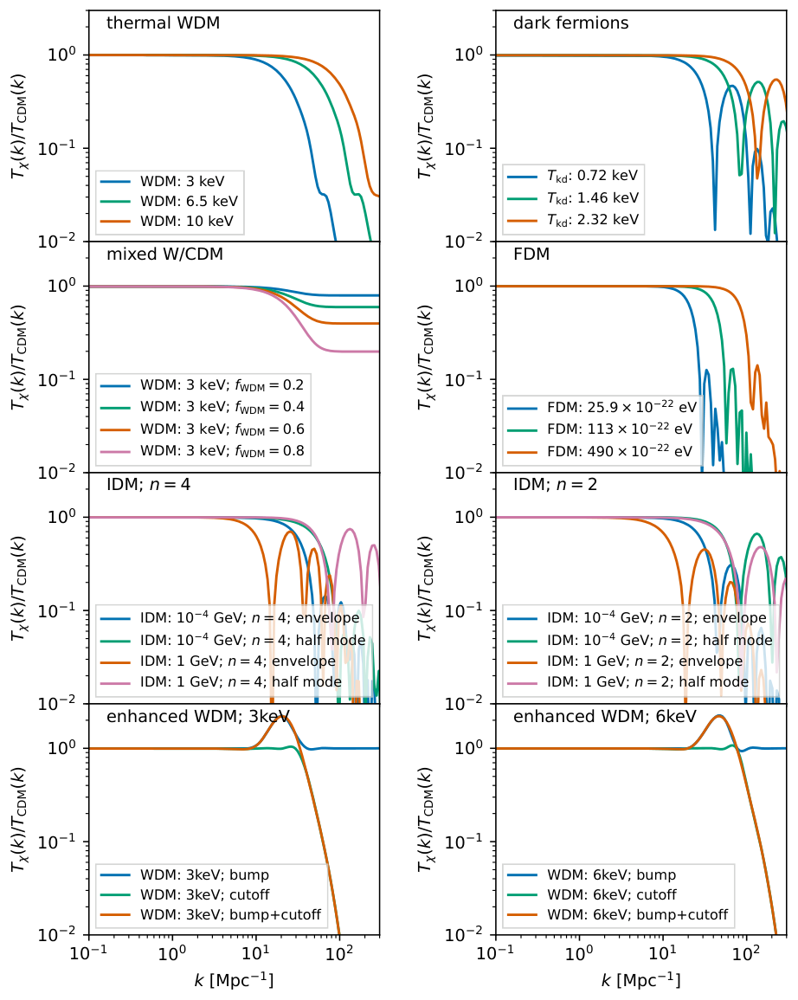
A single fitting formula, calibrated against both large cosmological volumes and high-resolution zoom-in simulations, reproduces the abundance of dark matter halos to about 12% over ten orders of magnitude in mass and across dark matter models including thermal relics, axions, and dark-sector interactions, with departures of 40 to 50% in a few mass ranges. Extended with a simple treatment of surroundings, it also captures how the local density of the universe shifts the number of halos.
Free-Streaming Length of Dark Matter from JWST Observations of 28 Strong Gravitational Lenses
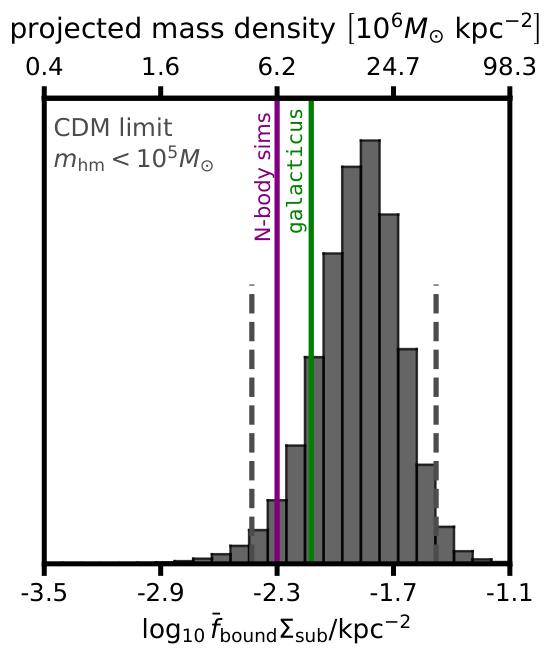
The pattern of distortions in 28 quadruply imaged quasars observed by JWST shows that dark matter still clumps on scales below about 10^7 solar masses, limiting the distance its particles stream before structure forms to under 6 to 7 kpc and requiring a thermal relic particle heavier than about 7 keV. Assuming dark matter is cold instead, the mass held in small clumps around elliptical lens galaxies is measured directly, confirming a central prediction of the standard picture.