My research aims to build a coherent theoretical picture of how galaxies form inside the dark matter web, and to use that picture to constrain the fundamental physics of dark matter itself. Most of this work happens through a single open-source modeling framework, Galacticus, that I have been developing for over a decade.
Theory & modeling
Galacticus — an open model of galaxy formation
Galacticus is a semi-analytic model that follows the assembly of dark matter halos and the formation of the galaxies inside them — gas cooling, star formation, feedback, chemical evolution, mergers, and the many environmental processes that act on satellite galaxies. It is fully open-source, written in modern Fortran with a Python and shell tooling layer, and is used by groups around the world.
Because Galacticus is fast and modular it can explore the consequences of new physics — alternative dark matter models, modified initial conditions, new feedback prescriptions — across enormous parameter spaces. That makes it well suited to the inverse problems that dominate modern cosmology: given a set of observations, what microphysics is allowed?
Fundamental physics
Constraining the microphysics of dark matter
On large scales dark matter behaves like a cold, collisionless fluid — but on the scales of galaxies and their substructure, the underlying particle physics matters. My group uses several complementary probes to test models beyond cold dark matter (CDM):
Self-interacting dark matter and the gravothermal instability
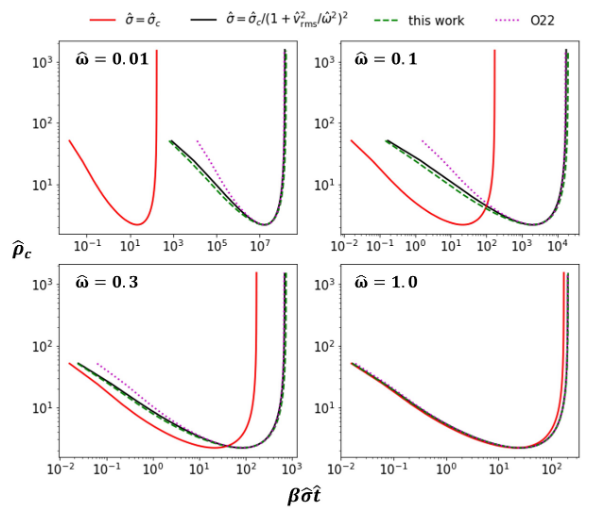
If dark matter particles scatter from each other, halos undergo a runaway core-collapse driven by the gravothermal instability. In Yang, Benson et al. (2022) we derive a universal scaling solution for this evolution that agrees with full N-body simulations to high accuracy while being orders of magnitude faster — opening up parameter-space studies that simulations cannot reach.
Tidal evolution of subhalos
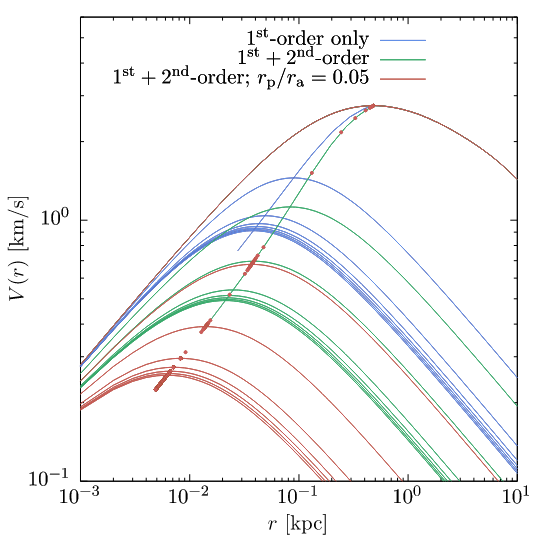
Subhalos lose mass and reshape as they orbit a host. In Benson & Du (2022) we developed a fast semi-analytic model of this evolution that reproduces high-resolution simulations — a key ingredient for predicting the abundance and structure of the substructure that dark-matter probes target.
Constraining warm dark matter with strong lensing
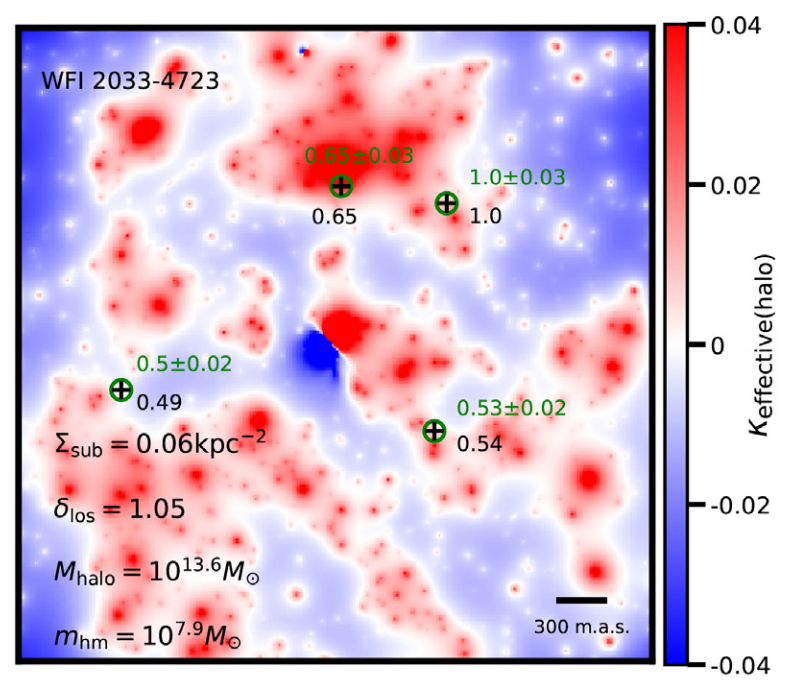
Tens of millions of model lensing systems generated with Galacticus were used in Gilman, Benson et al. (2020) to translate observed gravitational quad-lens flux ratios into a constraint on the warm-dark-matter particle mass.
Constrained merger trees
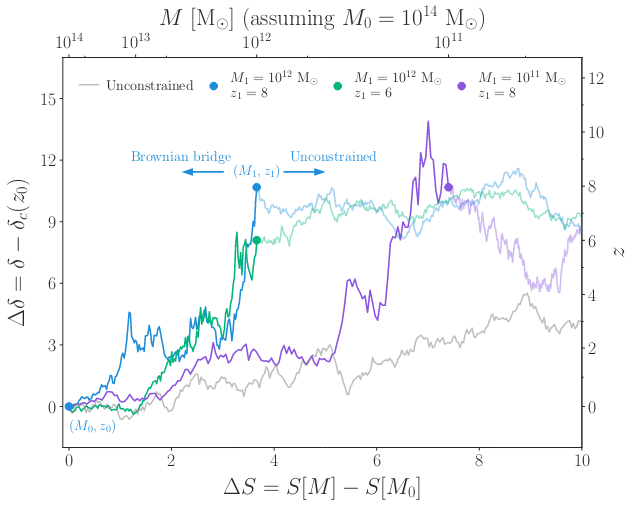
For predicting the Milky Way's substructure population it matters that we condition on the host being a Milky Way that hosts an LMC. Nadler, Benson et al. (2023) introduced a Brownian-bridge approach for constructing merger trees that automatically satisfy these kinds of physical constraints.
How baryons reshape the dark-matter halo mass function
Even within ΛCDM, baryons suppress small-halo formation in subtle but quantifiable ways. Benson (2020) quantifies that effect — a critical input for any program that aims to use small-scale structure to test dark-matter physics.
Surveys & forecasts
Synthetic universes for next-generation surveys
Roman Space Telescope — High-Latitude Spectroscopic Survey
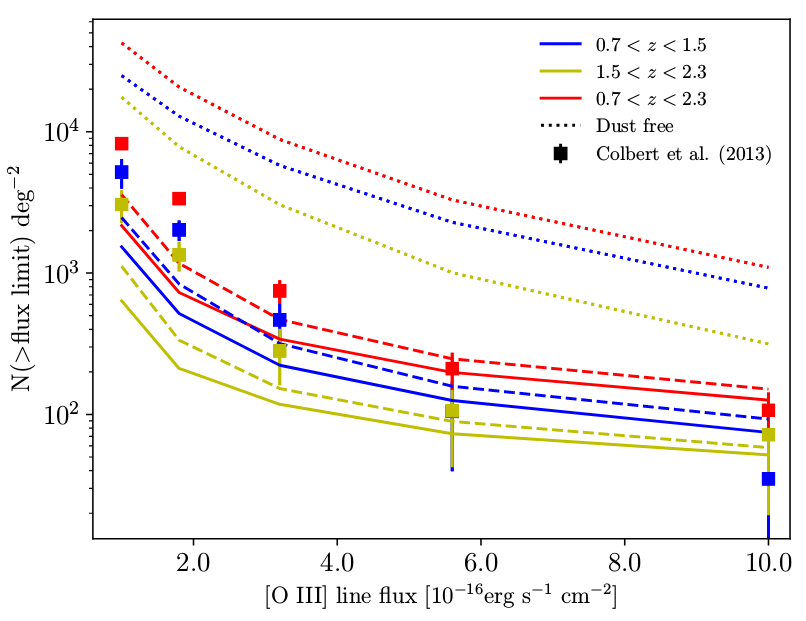
I am a member of the Roman Galaxy Redshift Survey Project Infrastructure Team (GRS PIT). We use Galacticus to build the synthetic emission-line galaxy populations that drive Roman's cosmological forecasts — predictions that have to fold together emission-line physics, dust attenuation, redshift completeness, and selection. See Zhai, Benson et al. (2019) for our [O II] forecasts.
NASA Open Universe
As part of the NASA Open Universe initiative, my group contributes the galaxy-formation modeling needed to tie together joint synthetic surveys for Rubin, Roman, and Euclid — making sure the same underlying galaxy populations appear consistently across each instrument's mock observations.
Synthetic skies for Rubin LSST
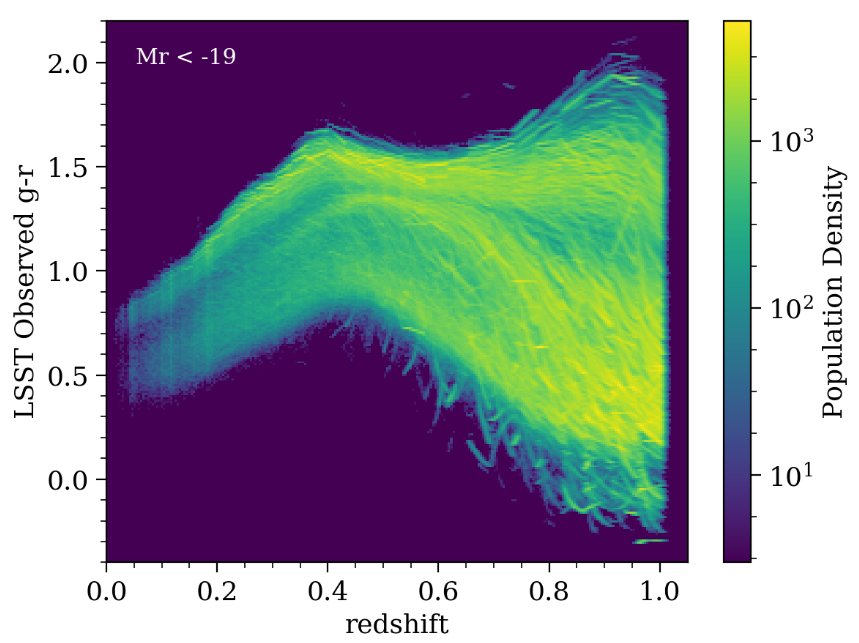
A Galacticus-based synthetic survey for the Rubin Observatory Legacy Survey of Space and Time, covering galaxy colors, lensing, and clustering, was published in Korytov et al. (2019).
Galaxy physics
Selected galaxy-formation results
The mass–metallicity relation of Milky Way dwarfs
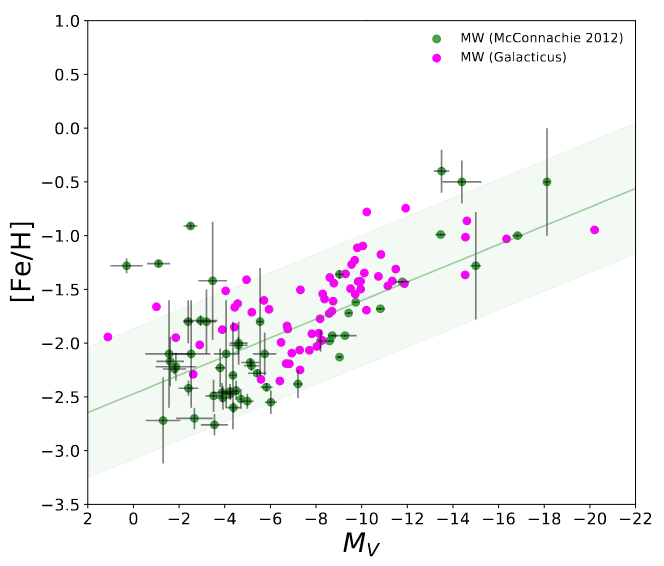
Dwarf galaxies are the most dark-matter-dominated systems we know. Weerasooriya, Benson et al. (2022) used Galacticus to predict the mass–metallicity relation of Milky Way satellites; the agreement with observations puts strong constraints on feedback and outflows in low-mass halos.
Dust extinction curves from radiative transfer
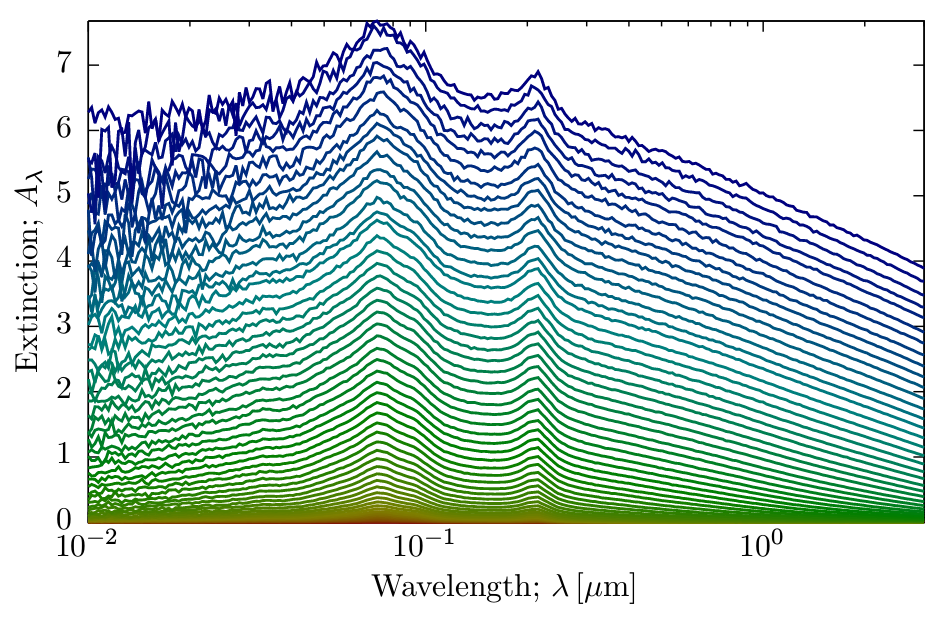
Survey forecasts need realistic dust attenuation. In Benson (2018) I computed extinction curves for a population of model galaxies using a Monte Carlo radiative transfer treatment.